Maryland Medical Transport Service Areas: 2026 Guide
Table of Contents
Last Updated: September 27, 2026
What Maryland Medical Transport Service Areas Actually Cover
Maryland medical transport service areas define which counties and regions a non-emergency medical transportation provider will serve, and they determine whether you can book a ride at all. At Transfer 4 U, we cover the entire state, which matters more than most people realize: many providers stick to the Baltimore metro and the Washington suburbs and leave rural counties unserved.
Non-emergency medical transportation (NEMT) is transportation for medical appointments, hospital discharges, and health-related errands when you are not experiencing an emergency. The distinction matters because 911 and ambulance services handle emergencies, while NEMT providers handle scheduled and same-day medical trips.
Coverage generally falls into three tiers, and knowing which tier your pickup address sits in tells you how far ahead to book:
Core metro counties, Baltimore City and Baltimore County, plus the close-in Washington suburbs in Montgomery and Prince George's counties. Highest trip volume, shortest wait times, and same-day booking is often possible.
Suburban and exurban counties, Anne Arundel, Howard, Carroll, Harford, Frederick, Charles, and Calvert. Served on standard scheduling windows, usually 24 to 48 hours ahead.
Rural and outlying counties, the Eastern Shore (Cecil, Kent, Queen Anne's, Caroline, Talbot, Dorchester, Wicomico, Worcester, and Somerset), Southern Maryland (St. Mary's), and Western Maryland (Washington, Allegany, and Garrett). Providers here may limit trips to certain days, require longer lead times, or decline trips that cross into another region.
A useful way to think about it: the state's regional transit structure already divides Maryland into service regions, and many NEMT providers inherit those same boundaries. A provider licensed and staffed for the Baltimore region may not have a vehicle positioned to serve Garrett County on the same day. The Maryland Department of Transportation overview of transit resources is a starting point for understanding how regional transport is organized across the state.
County-by-County Coverage and Regional Cross-County Travel
Cross-county travel is where coverage gets complicated, and it is the single biggest pain point for rural residents. A patient in Garrett County may need a specialist at a Baltimore hospital. A patient on the Lower Eastern Shore may need a procedure in Annapolis or Salisbury. Not every provider will cross regional boundaries, and the ones that will often charge differently or require more lead time.
Before booking, confirm three things in writing:
Is your pickup county served? Ask for the county list, not a vague "we serve the state" answer.
Is your destination county served? A provider may pick you up locally but not be authorized or staffed to deliver you across the state.
Does the trip cross a regional transport boundary? Long-haul trips between, say, Western Maryland and the Baltimore metro often require a different provider, a transfer point, or a dedicated long-distance vehicle.
Most providers publish a service area map or county list. If yours doesn't, ask directly and get the answer in writing. A provider that hesitates on this question will likely hesitate on your ride day too.
Pro Tip For recurring cross-county trips, dialysis three times a week, for example, ask whether the same driver and vehicle can be assigned each time.
If you are unsure whether your trip crosses a boundary, call the provider with both the pickup address and the destination address before you book. That one call prevents most cross-county scheduling failures.
Wheelchair Accessible Medical Transport Maryland: What to Expect
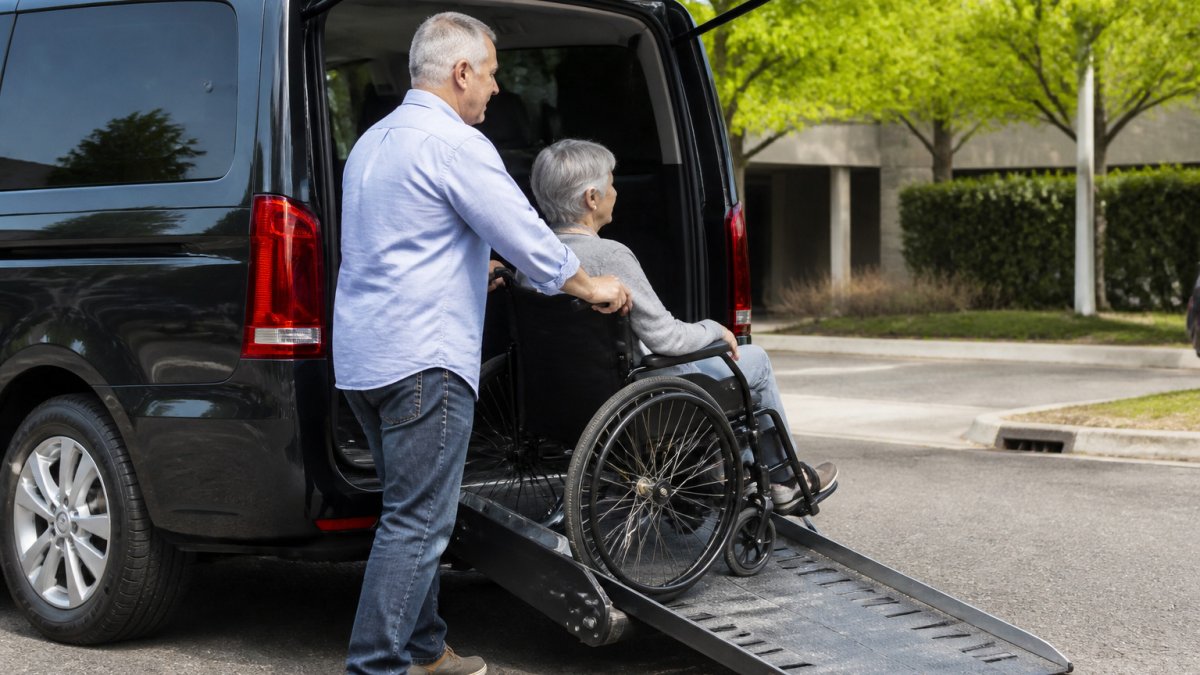
Wheelchair accessible medical transport in Maryland should include a ramp or lift, four-point tie-down securement, and a driver trained to assist with boarding. Anything less is not accessible transport; it is a standard vehicle with extra space.

Expect the driver to secure your chair before the vehicle moves, confirm your destination and appointment time, and offer assistance with the door and any personal items. If you travel with oxygen equipment, a service animal, or a specialized chair, say so at booking rather than at pickup.
Ambulatory, Wheelchair-Bound, and Stretcher-Bound Transport
Providers typically sort riders into three categories, and each requires different equipment:
Transport Type | Vehicle Requirement | Typical Use Case | Booking Lead Time |
Ambulatory | Standard sedan or van | Walking with minimal assistance | Same day often possible |
Wheelchair-bound | Ramp or lift-equipped van | Wheelchair users needing securement | Usually 24-48 hours |
Stretcher-bound | Gurney-equipped vehicle | Non-weight-bearing or bed-bound patients | Longer lead time, staffed by two attendants |
Pro Tip If your mobility level changes between booking and your appointment, call the provider before pickup day. Switching from ambulatory to wheelchair transport at the curb delays the trip and may mean the assigned vehicle can't accommodate you.
Maryland Medicaid Transportation Program Eligibility
Maryland's Medicaid transportation benefit helps eligible members reach covered medical appointments, and it is administered through the state's Medicaid program rather than through individual providers. The program generally functions as a last resort: members are expected to use other available transportation first, and rides must be tied to a covered medical service.
Eligibility criteria typically include active Medicaid enrollment, a medical appointment that Medicaid covers, and no other reasonable way to get there.
Private vs. Public Payor Comparison
The choice between public and private payment comes down to control versus cost.
Factor | Medicaid Transportation | Private Pay |
Who schedules | State-contracted broker | You or your family |
Trip approval | Must be medically covered | Any trip you book |
Wait times | Varies by region and demand | Set by provider availability |
Errands and shopping | Generally not covered | Covered |
Provider choice | Limited to contracted providers | You choose |
Watch Out Do not assume a Medicaid ride will arrive on time for a tight appointment window. Approval and dispatch are separate steps, and a late approval can leave you without a vehicle.
How to Schedule Medical Transport for Hospital Discharge
Scheduling transport for a hospital discharge requires more lead time than a routine appointment because discharge timing is unpredictable and the vehicle must match your mobility level. Start the process as soon as the discharge date is discussed, not the morning you leave.
Step-by-Step Booking Checklist
Confirm your discharge date and approximate time with the care team
Identify your transport type: ambulatory, wheelchair, or stretcher
List all equipment: wheelchair, oxygen, walker, service animal
Verify your pickup address and entrance, including any gate codes
Confirm whether insurance, Medicaid, or private pay covers the trip
Book at least 24 to 48 hours ahead where possible
Get a confirmation number and the provider's direct phone line
Ask what happens if discharge runs late or early
Save the driver contact and dispatch number in your phone
Have a backup plan if the first provider cannot accommodate you
Transportation for Older Adults and Disability Services
Older adults and people with disabilities often qualify for more than one transportation assistance program, and stacking options gives you a backup when one falls through. Beyond Medicaid, the practical sources of help fall into four buckets, and most people only know about one of them.
How to Build a Backup Plan Before You Need One
Call your Area Agency on Aging or local CIL and ask for a printed or emailed list of every transport option that serves your address.
Note each program's eligibility rules, booking window, and phone number in one place.
Identify at least one option that does not depend on Medicaid, so a coverage gap or approval delay does not strand you.
Confirm whether each option can accommodate your specific mobility level and equipment.
Key Takeaway Program stacking is not about finding the cheapest ride, it is about never being without one.
If you would rather not coordinate multiple programs yourself, a private NEMT provider can serve as a fallback for time-critical trips while you work through public program enrollment.
Accessibility Standards and Specialized Transit Requirements
Accessibility standards for medical transport in the United States are shaped by the Americans with Disabilities Act, which requires accessible vehicles and prohibits discrimination against riders with disabilities. For wheelchair users, the practical benchmarks are a working ramp or lift, proper four-point securement, and a driver who knows how to use both.
Conclusion
Coverage gaps, payor confusion, and mobility mismatches cause most medical transport problems, and each one is avoidable with the right questions up front. Transfer 4 U provides non-emergency medical transportation across Maryland with specialized wheelchair-accessible vehicles, accommodation for medical equipment and service animals, and door-to-door assistance for riders of all ages. Our team handles hospital discharges, recurring medical appointments, and personal errands with the same care. Contact Transfer 4 U to confirm your service area and book a ride that fits your mobility needs.
Frequently Asked Questions
How do I qualify for Medical Assistance transportation in Maryland?
Qualification for Maryland Medicaid transportation typically requires active enrollment in a Medicaid program and a verified medical need with no other means of transport. Eligibility criteria often include income limits and specific health conditions. Contact your local health department or Medicaid member services to confirm your status and request an assessment for non-emergency medical transportation benefits.
Does Maryland Medicaid cover non-emergency medical transportation?
Maryland Medicaid generally covers non-emergency medical transportation (NEMT) for eligible members who need rides to medical appointments. Coverage usually requires prior authorization and use of approved providers. However, Medicaid is often the payor of last resort, meaning you must exhaust other transportation options first. Check with your health plan for specific coverage rules.
How far in advance should I schedule medical transport in Maryland?
For non-emergency medical transportation, booking at least 48 to 72 hours in advance is standard practice. For wheelchair accessible transport or stretcher-bound services, allow more time to ensure vehicle availability. If you need to schedule medical transport for hospital discharge, coordinate with the discharge planner as early as possible to avoid delays.
Are there wheelchair-accessible transport options available throughout Maryland?
Yes, many providers offer wheelchair accessible medical transport in Maryland, but coverage varies by service area. Urban and suburban counties typically have more options than rural regions. When booking, confirm the vehicle can accommodate your specific mobility equipment and that the driver is trained in accessibility standards.
Contact Us


Comments